Special Guests
Saturday, February 7, 1998

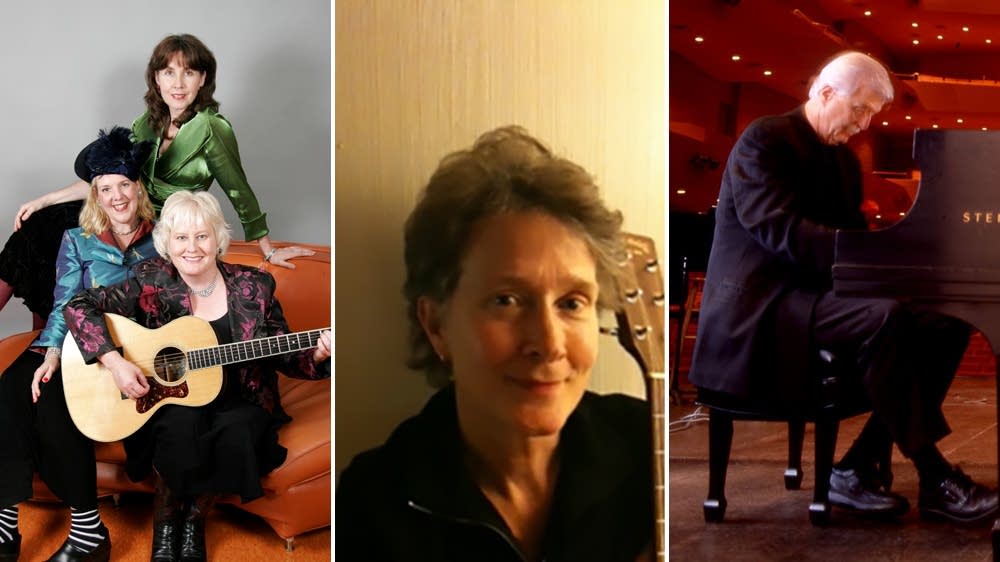
Jean Redpath is recognized as the foremost interpreter and champion of traditional Scottish music. Redpath attended Edinburgh University, where she majored in medieval studies, a field of study devoted to the predominantly oral tradition of the Scottish people. During her years at Edinburgh University, Redpath made use of Edinburgh University's vast research archives, material documenting the traditions, legends, and music of the Gaelic and Scottish-speaking people. She also was introduced to the Folk Song Society, and her interests in folk music eventually led her to America. In 1961, she arrived in the U.S. and joined in a few "hootenannies"-first in San Francisco and then in Greenwich Village. Her spontaneous performances there led to performances in folk music clubs and marked her arrival on America's folk music scene. Redpath also continued her academic associations as an artist-in-residence and folklore lecturer, first at Wesleyan University in Connecticut and later at the University of Stirling, Scotland. In 1977, Redpath was honored when she was chosen as one of only four performers commanded to appear before Queen Elizabeth II during the Queen's Jubilee Year. She was also awarded the prestigious MBE (Member of the British Empire). A tireless performer, Redpath has played hundreds of concerts throughout the U.S. and has recorded more than three dozen albums. Many of those albums have been devoted to a Herculean task: recording 323 songs written by Scotland's beloved poet, Robert Burns, and arranged by the late Serge Hovey. Redpath and Hovey worked together to produce seven volumes of Songs of Robert Burns (Philo Records). She has also made four other-largely a cappella-recordings of Burns' work (on Scottish Records). Combined, the sum total of Burns' songs recorded by Redpath nears the 200 mark. Her most recent recording is A Woman of Her Time (Jean Redpath Records). Appearing with Redpath this evening are Abby Newton (cello), Jacqueline Schwab (piano), and Sue Richards (Celtic harp). Cellist Abby Newton has performed and recorded with Jean Redpath and other folk artists for nearly two decades, all the while maintaining a career as a classical musican with such groups as the American Symphony and the Manhattan Philharmonic. Her solo work can be heard on Crossing to Scotland (Culburnie Records). Jacqueline Schwab played piano on the Grammy Award-winning soundtrack for the Ken Burns' documentary, The Civil War, and has performed on six other Ken Burns soundtracks. A 20-year member of the English country-dance band Bare Necessities, Schwab recently released her first solo CD, Mad Robin (Midsummer Recordings). Sue Richards is a four-time U.S. National Scottish Harp Champion. She can be heard on dozens of recordings, and on three solo albums on the Maggies Music label, including the award-winning Morning Aire. Richards also plays with Ceoltoiri Irish band and Ensemble Galilei, a Celtic and early-music group.

Studs Terkel calls himself a "disc jockey," a reference to the his role as host of the Peabody Award-winning talk show, The Studs Terkel Program, heard for 45 years in Chicago on WFMT. On New Year's Day, Terkel aired his last regularly scheduled radio show. He'll spend the next two years working on the Studs Terkel-WFMT Archive, which will become a Chicago Historical Society collection of 7,000 hours of interviews. Before starting with WFMT in 1953, Terkel had starred in Studs' Place, one of the programs that created the Chicago school of television. The show began airing in 1950, the year that Joseph McCarthy began claiming that he had a list of Communist Party members in the U.S. State Department. The popularity of Studs' Place couldn't keep it on the air: the program was dropped by NBC when Terkel wouldn't reverse his "pro-Communist" positions in favor of price and rent controls and against the poll tax and Jim Crow laws. By the mid-'60s, Terkel's interviews on WFMT began to be noticed outside of Chicago. In 1965, his first oral history was published, Division Street: America, about class differences in Chicago. Terkel calls his writing "bottom-up history ... [interviews with] ordinary people who have something real to say about themselves." To compile each of his books, Terkel meets with hundreds of these "ordinary people" and then sifts through the hours upon hours of resulting tape until the interviews are distilled down to bare truth. He won the Pulitzer Prize for his 1985 book The Good War, the story of World War II told through soldiers and civilians on both sides. Last May, when Terkel turned 85, he was inducted into the American Academy of Arts and Letters. Terkel's latest book is My American Century (New Press), the best of his tapes/social chronicles. In November 1997, the National Book Foundation gave Terkel a medal for Distinguished Contribution to American Letters. The award is given to an individual who has enriched the nation's literary heritage through a lifetime of work.


GK's New Holiday Story
A comic novella about a Hawaii-bound holiday traveler who ends up stranded in his North Dakota hometown.

Read or Listen to the first chapter»
Audio edition also available»

Western Caribbean Cruise

The Prairie Home cruise has become legendary on two of the Seven Seas and now is setting sail on a third, a weeklong spring break cruise of the western Caribbean along the Mexican coast, and it leaves March 14 from Tampa.

More Information»

Pilgrims: A Wobegon Romance

Stories of a Wobegon romance far from home, all delivered with Garrison Keillor's trademark humor.

Read the first chapter»

Signed Copies Available»

Life Among the Lutherans

The latest collection of Lake Wobegon short stories gathered from live broadcasts include Confirmation Sunday, the church directory photos, Pastor Ingqvist's leather bound sermons along with song lyrics and the "95 Theses," among others. Companion audio also available.

Order now!»
American Public Media © |   Terms and Conditions   |   Privacy Policy